In the first of the Gateway to Local Adoption series, Visions4Health caught up with Dr Nick Merrifield to discuss his views on the ‘left shift’ and moving healthcare from hospital to community.
By its very name, “neighbourhood working” conjures images of community hubs, friendly faces, and grassroots action. But in today’s NHS, what does it mean and how do we enable it? The short answer is – it depends.
Originally developed around the concept of Primary Care Networks (PCNs) serving 30,000–50,000 people, neighbourhood working has since evolved, and in some areas, fractured. While some regions remain committed to localised models and smaller-scale initiatives, others now describe neighbourhoods as whole boroughs or hospital catchment areas, serving upwards of 150,000 people. Both interpretations hold merit.
Within larger neighbourhoods we see integrated initiatives tackling proactive, anticipatory care. In southwest London, Kingston and Richmond’s collaborative model, for instance, spans 400,000 people and links primary care with other NHS providers, social care and voluntary sector partners. These efforts support the left shift from reactive treatment to prevention, keeping people healthier and out of hospital. Are they neighbourhood working? Absolutely, but they look nothing like a drop-in clinic for carers hosted in a local community centre.
And therein lies the challenge: neighbourhood working is both strategic and grassroots, macro and micro.
While NHS England recognises the concept in policy documents, it has yet to define its scope or purpose clearly. That absence has created space for innovation, but also uncertainty. With the forthcoming 10-year plan expected to provide more structure, stakeholders are left to build systems and partnerships based on local needs.
In the meantime, the focus must remain on collaboration. Trusts, PCNs, community services, and voluntary groups are forming joint ventures, provider collaboratives, and integrated care strategies. These arrangements need robust leadership, community voices, and a shared vision to succeed.
Neighbourhood working should never be reduced to system diagrams and governance charts. It must be shaped by local need, whether that’s prescribing support through embedded pharmacists or outreach to non-English speaking residents. It’s about agility and alignment, not uniformity.
Ultimately, enabling neighbourhood working means embracing its complexity. There’s no one-size-fits-all blueprint, but there is a common goal: delivering better, more personalised care, closer to where people live.
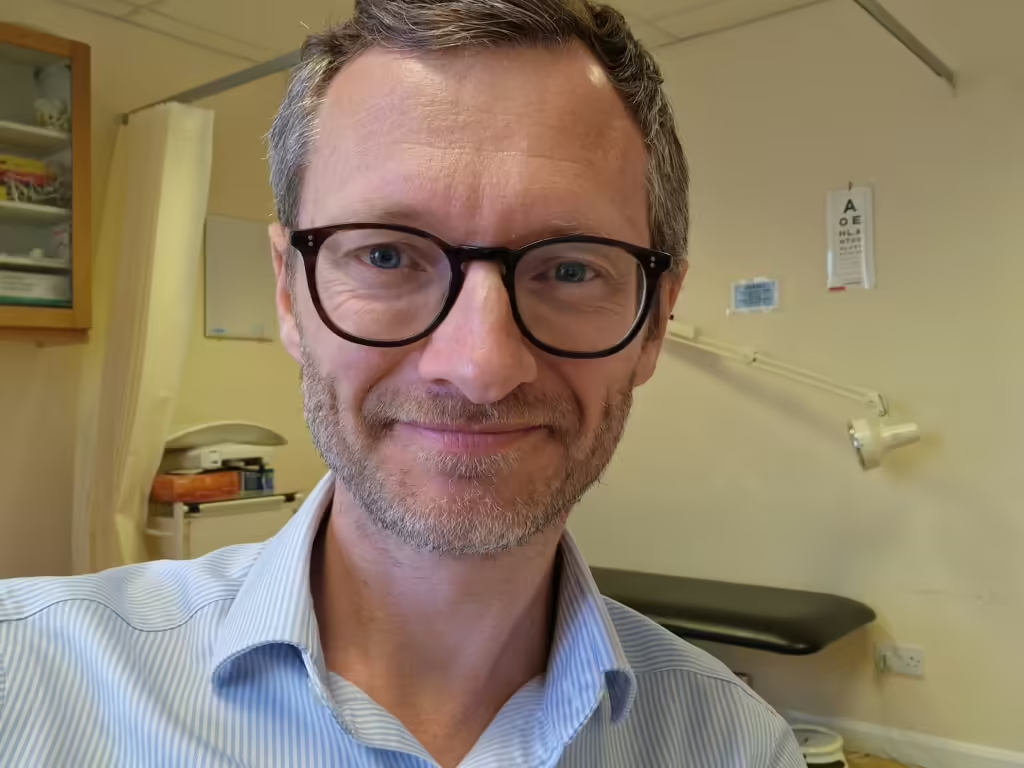
Dr Merrifield is a GP in Kingston-upon-Thames, Primary Care Network Clinical Director, GP Federation Director, Clinical Educator and Deputy Clinical Director in the South West London Integrated Care System. He’s a believer in collaborative leadership, the potential for primary care at scale and the power of communities and localism. He is an advisor to pharmaceutical industry, higher education and healthcare policymakers at regional and national levels and is a regular speaker at healthcare conferences. Dr Merrifield also sits on Visions4Health’s Healthcare System Council.